
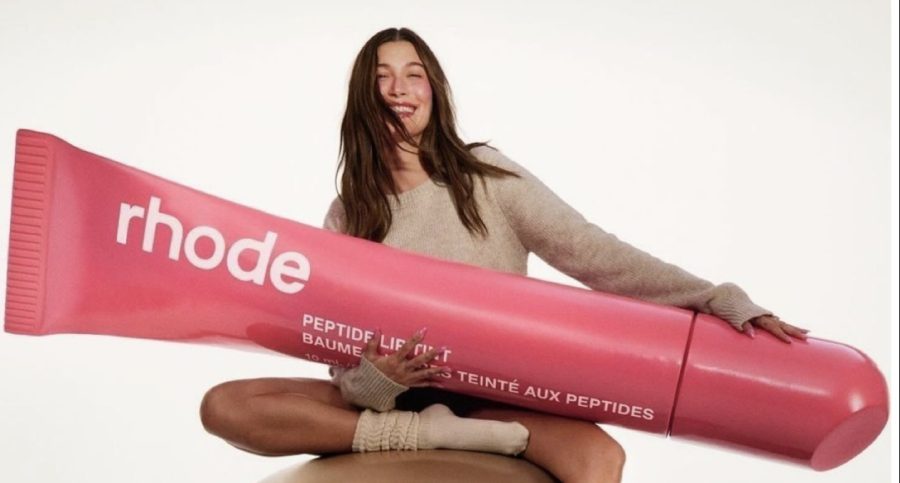
By now everyone with access to social media is most likely aware of Hailey Bieber and her brand Rhode Beauty. The brand was officially launched in 2022, and from that moment on, the game was completely changed when it came to marketing and PR for celebrity brands.
Hailey Bieber is known for being a trailblazer for the clean girl aesthetic, she’s plastered all over every girl’s mood board. Her aesthetic is one that most aim to embody, and so when this brand was released, there was no hesitation to make a purchase. In the last four years of its existence, Rhode Beauty has garnered a great deal of success, the brand has become highly profitable and was recently acquired by E.l.f. Beauty for up to $1 billion.
As mentioned, Hailey Bieber is known for her clear skin and clean girl persona, so when it came to marketing this brand, it wasn’t advertised as being just another celebrity brand but rather a lifestyle you could aspire to. By using influencers and trendy celebrities that mirror the brand’s identity, consumers felt more inclined to purchase from the brand as it gave them a sense of belonging.
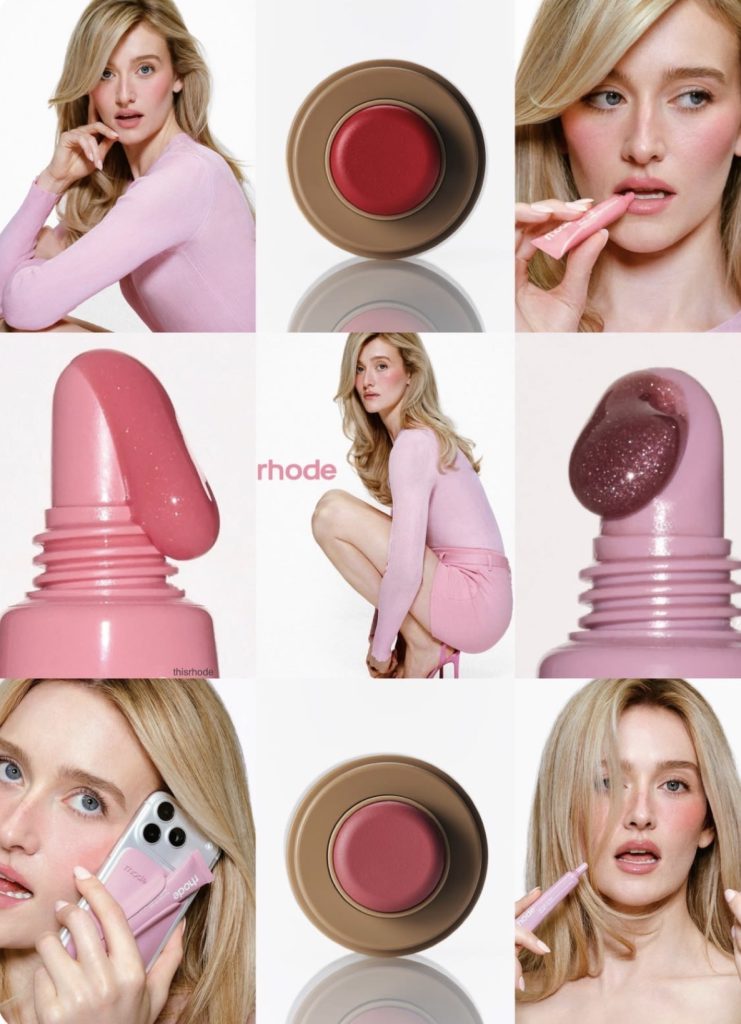

For example, Rhode released phone cases where consumers could secure their lip treatments to them. The owners of the phone case and lip treatment combination portray an aesthetic that only some will truly understand. This wasn’t just another beauty item, but rather a display of personality. This all links to Stuart Hall’s theory of encoding and decoding.
Hall’s communication theory of encoding and decoding explains how media messages are produced and interpreted, it argues that messages are intentionally encoded with meaning and are consciously decoded by audiences. In this case Rhode encodes their product by heavily capitalising off of Hailey’s clear skin and aesthetic by featuring her in campaigns that are visually pleasing and provide consumers with a lifestyle they can buy into.
These campaigns then get decoded by audiences and are interpreted exactly as intended, which is as authentic and chic, and they believe that by making a purchase, they are able to replicate the brand’s ideology.
However, Rhode’s marketing and the brand as a whole can be decoded in ways that are not intended by the brand. One of which is that some would not fall for it and just see it as another celebrity brand, not something worth spending money on. This became a common thought amongst those online when the viral lip treatments were first released. Many took to social media to complain about the quality of the product, stating that after some time, it became grainy, to which others responded with solutions and said to put the product in hot water. This sparked further outrage and annoyance as audiences claimed this is not something they should have to do, resulting in people feeling de-influenced from purchasing their other products.
This demonstrates that encoding and decoding is not entirely a linear form of communication and that there’s no guarantee that information will be understood as intended.
REFERENCES
Hall, S (1973) Available at: https://blog.richmond.edu/watchingthewire/files/2015/08/Encoding-Decoding.pdf
Mccormack, C. (2025) Available at: https://www.beautyindependent.com/is-rhode-worth-1-billion/
Steidley, M. (n.d) Available at: https://www.strikemagazines.com/blog-2-1/nbsprhodes-recipe-for-success-how-hailey-bieber-is-redefining-marketing-culture
X, Yuting (2022) Available at: https://www.researchgate.net/publication/391275214_An_Overview_of_Stuart_Hall’s_Encoding_and_Decoding_Theory_with_Film_Communication


