
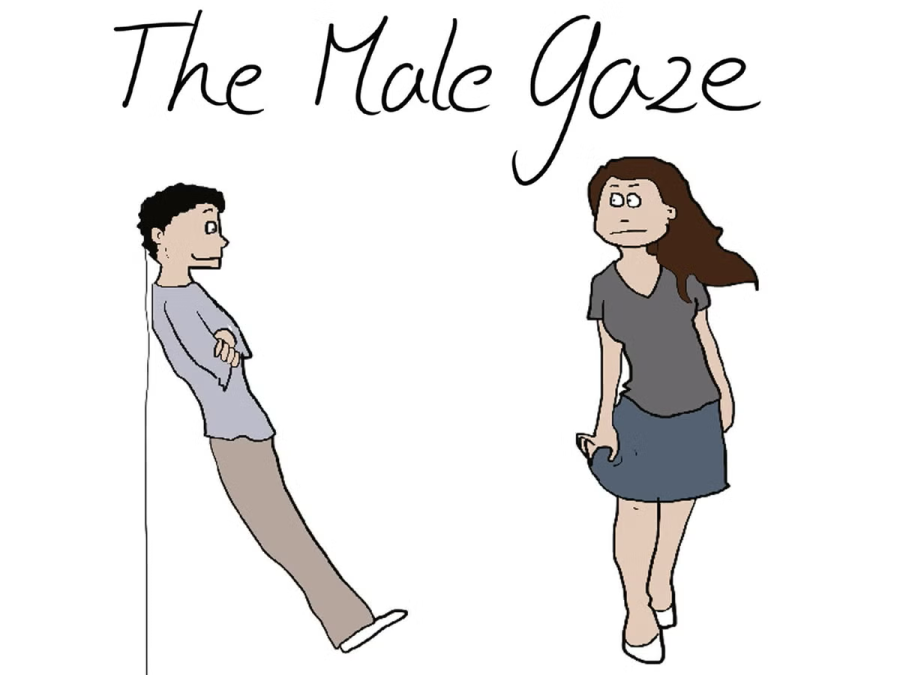
The concept of the ‘male gaze’ has been central to feminist film theory for decades. Feminist scholars argue that the male gaze is tied to hegemonic masculinity, shaping the way women’s bodies are framed, consumed, and controlled within visual culture. According to Oxford Reference, the male gaze reduces women to objects to be surveyed. In cinema, this gaze operates through narrative conventions, cinematography, and the broader structure of media production ultimately positioning women as sexual objects designed for the pleasure of heterosexual male viewers. This dynamic not only shapes how women are represented on screen but also influences how women, as viewers, are expected to engage with films. In many cases, female audiences are subtly encouraged, if not compelled, to adopt the same male perspective that produced the film in the first place.Hollywood, in particular, reinforces this gaze through the content it creates and the systems of power that sustain it.Who Controls Representation? This raises several critical questions:
Who owns the media and cinema industries?
Who has the authority to direct and write these films?
What do these creators prioritise when producing content?
What messages are encoded into the television programmes and films we consume?
These questions reveal the structural nature of the male gaze: it is embedded not only in individual films but in the institutions and ideologies that shape mainstream media.
How the Gaze Operates
We can understand the gaze through a sequence of roles:
1. The body being programmed, the subject placed under the gaze.
2. The director who constructs the film decides what is shown and how it is framed.
3. The spectator who receives the gaze, interpreting, absorbing, or resisting what is shown.
4. The act of returning the gaze, pushing back, reclaiming subjectivity, or subverting the viewing position.
bell hooks’ Intervention on the opposiyionla gaze
bell hooks offers a crucial extension to this conversation through her concept of the ‘oppositional gaze’. She argues that Black women, historically excluded or stereotyped in mainstream media, have developed a resistant, critical way of looking.
When films fail to represent Black female identities, Black women often take pleasure not in the narrative itself but in analysing and deconstructing the film’s assumptions. This becomes a form of agencythe ability to look back rather than simply absorb what is on screen.
Joey Soloway and the Female Gaze
Joey Soloway’s work brings renewed attention to the ‘female gaze’, reframing it as a tool for social and artistic transformation. Soloway asks what it would mean to centre the lived experiences, emotions, and subjectivity of women in cinema not as objects of desire but as fully seen, fully felt protagonists.
In their discussion of filmmaking, Soloway emphasises the importance of prioritising the woman’s body, not as an object of display but as a site of experience. The female gaze becomes a “subjective camera,” one that communicates feeling, intimacy, and interiority. Instead of the director imposing emotion onto the actors, the filmmaker becomes part of the emotional exchange, acknowledging their own body and presence as part of the process.
Hannah Wilke and Embodied Visibility
Artist Hannah Wilke further highlights the significance of the woman’s body as a communicative tool. Her work expresses a desire for women to be seen not as objects but as subjects who control their own visibility. For Wilke, the body holds political and artistic power it is a medium for being seen, felt, and understood on one’s own terms.
The Female Gaze as a Political Practice
Ultimately, the female gaze is not simply the inverse of the male gaze. It is a socio-political call for justice within art-making. It demands that creators and audiences recognise women as subjects beings with agency, complexity, and interior worlds rather than as aesthetic objects constructed for consumption.
As feminist thinkers such as hooks, Soloway, and Wilke remind us, rethinking the gaze is not only about representation on screen. It is also about transforming the structures that determine who is allowed to create, who is allowed to be seen, and how we learn to look in the first place.
References
TIFF Talks (2016). Joey Soloway on The Female Gaze | MASTER CLASS | TIFF 2016. YouTube. Available at: https://www.youtube.com/watch?v=pnBvppooD9I
Blackboard (2025). Blackboard. [online] Westminster.ac.uk. Available at: https://learning.westminster.ac.uk/ultra/courses/_102764_1/outline/file/_6032002_1 [Accessed 2 Dec. 202
Blackboard (2025). Blackboard. [online] Westminster.ac.uk. Available at: https://learning.westminster.ac.uk/ultra/courses/_102764_1/outline/file/_6032698_1 [Accessed 2 Dec. 2025].
Maloney, L., Miller, A., Nix, S. and Osborn, B. (2016). The Oppositional Gaze: Black Female Spectators. [online] ENGL 359. Available at: https://xuengl359.wordpress.com/home/theoryguide/the-oppositional-gaze-bell-hooks/ .


This post is a very valuable insight into how various feminist intellectuals can broaden our knowledge of gaze. I particularly appreciate the way in which you tie the structural power of the male gaze to the substitute descriptions that hooks, Soloway and Wilke provide. You make it very clear that the female gaze is not simply the opposite, but a political and artistic reconstruction of the subject of being. I thoroughly enjoyed reading.
The discussion of the male gaze underscores its pervasive influence in shaping cinematic representation and audience perception. While the text effectively situates the concept within feminist theory, it risks oversimplifying the complexity of spectatorship by framing women primarily as passive recipients of patriarchal norms. The inclusion of bell hooks’ oppositional gaze and Soloway’s female gaze introduces necessary counterpoints, yet these interventions could be explored further to challenge the binary of male versus female gaze. Moreover, the structural critique of media ownership is compelling but underdeveloped; without deeper engagement with economic and institutional power, the argument remains largely theoretical.