
In 1975, Laura Mulvey coined the term “Male Gaze,” created to theorize and understand the idea that visual media is continuously structured around heterosexual male perspectives that turn women into objects of visual pleasure rather than full subjects with agency. Despite its origins in cinema, Mulvey’s framework has been applied throughout different visual mediums, including sports. Women’s football, one of the fastest growing global sports, offers a perspective for looking at how the male gaze shapes not only how female athletes are represented, but how the sport itself is marketed and consumed.
At its core, the male gaze positions women as passive, while men are seen as active beings. In film, this often relates to things like camera angles and narrative structures. In women’s football, this shows up in broadcast choices (whether or not they will televise a game), sports journalism, and marketing. While men’s football is almost exclusively framed around athletic performance and competitive intensity, women’s football is far more likely to be framed through aesthetics. Recently, SkyTV ended a recently created social media channel called Halo that aimed to create sports content relatable towards women. “One post saw a clip of Manchester City players Rayan Cherki and Erling Haaland combining for the latter to score against Bournemouth, given the caption “How the matcha + hot girl walk combo hits” (bbc.co.uk).”
Another example of the male gaze affecting women’s football is how in sports journalism, there tends to be a focus on things other than their athletic abilities. Topics like dating and fashion, and petty fighting are discussed and highlighted. Motherhood is also a large focus.
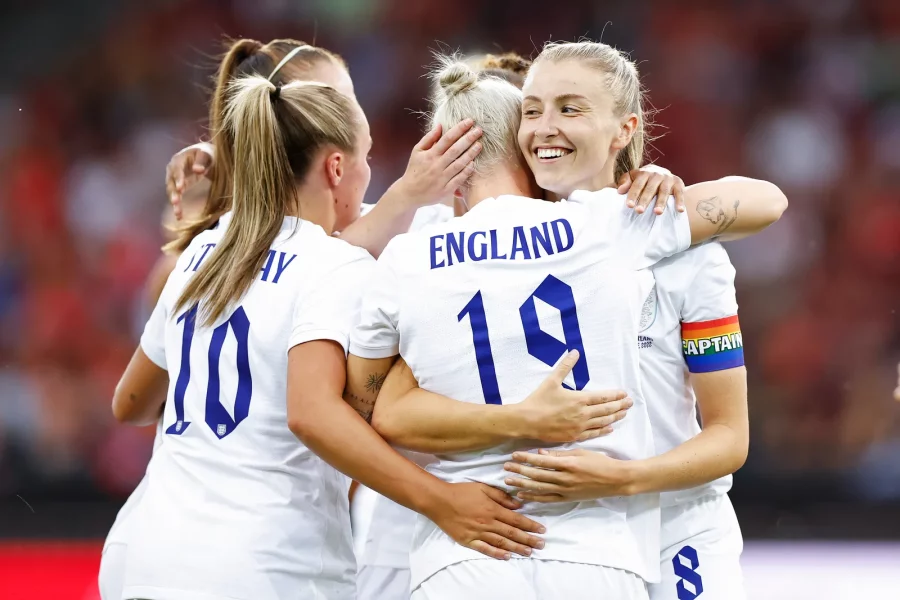
The male gaze also shapes how audiences are encouraged to value women’s sports and how the players present. When players are more soft and feminine and their bodies meet the typical societal standards, they are met with love and admiration. When players’ bodies look more masculine presenting, their testosterone levels are called into question. This typically only affects POC women’s football players as well, such as Barbara Banda for example.
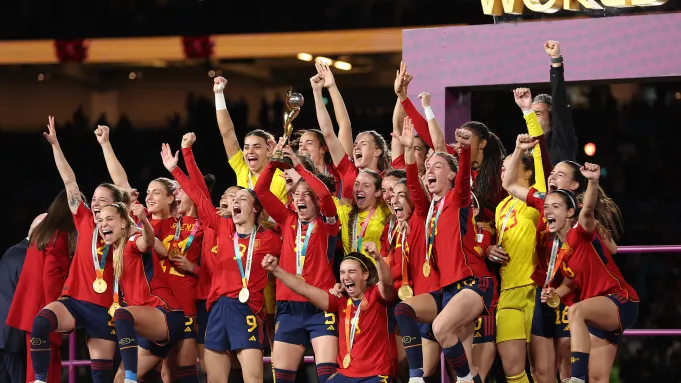
Despite all of this, women’s football also provides compelling examples of athletic ability and subverting the male gaze. Teams and players have continued to take control over their own narratives through social media, documentaries, and public advocacy. By highlighting their hard work, they demand recognition as athletes first, public figures second. The success of events such as the FIFA Women’s World Cup and the rise in interest in leagues like the NWSL in America has shown that when women’s football is presented with the same seriousness and respect as men’s, that fans, who have always shown interest, respond enthusiastically.
Understanding women’s football through the lens of Mulvey’s theory, helps us identify lingering biases. There are still so many issues to fix within women’s football, but there has also been immense progress. The sport itself gives so much representation to young women, women of color, LGBTQ+ individuals, and more. As more women enter different roles within sports, the visual language continues to evolve.
Sources:
Mulvey, Laura. “Visual Pleasure and Narrative Cinema.” Screen, vol. 16, no. 3, 1975, pp. 6–18.
Rossiter, Emma, and Eleanor Doyle. “Sky Sports Axes ‘sexist’ TikTok Channel Halo After Three Days.” BBC News, 16 Nov. 2025, www.bbc.co.uk/news/articles/cdrz8g7evyxo.


Excellent point on how the gaze impacts marketing and consumption! I contend that the attempt to frame women’s football through “aesthetics” (such as the unsuccessful SkyTV Halo channel) is an antiquated corporate tactic rather than merely being biased.
Even in a competitive environment, traditional media institutions maintain that the male gaze is the most dependable method of extracting consumer cash from female bodies. They overlook the fact that women’s sports have unrealized economic potential due to their meritocratic appeal and fans’ desire to invest in real athletic ability rather than a sexualized image. The popularity of international competitions demonstrates that spectators are prepared to spend money when the action is prioritized over aesthetics.
I have also observed similar phenomena. Not only in football, but also in volleyball, sprinting and other sports, people often pay attention to the strength of male athletes and the appearance and private life of female athletes. Interestingly, my motherland, China, a country where women win two-thirds of the total MEDALS in Olympic sports, still likes to judge everything about female athletes except for their achievements. A female sprinter, Wu Yanni, who has won many national championships, is still criticized by netizens for wearing makeup on the field. How ironic this is!
I really enjoyed reading this. You explain the idea of the male gaze in a way that makes it easy to understand, and the examples from women’s football feel very real and familiar. I especially liked the part about how the media focuses on players’ looks or personal lives instead of their skills, because it’s something we still see all the time. It’s also encouraging to read about how players are taking control of their own stories. Overall, this was a clear and thoughtful post that made me think more about how women’s sports are presented.
This is a brilliant post that brings Mulvey theory to bear on the present state of women in football. Particularly, I like how you point out the undertones of the male gaze through the media coverage, advertisements and social beliefs. Alternatively, one would be interested in continuing to elaborate how players and fans are activists against these stories, by their agency is an influential component to the development of the sport. All in all, a great analysis!
Bringing Mulvey’s male gaze into women’s football is a brilliant move – the Halo example and the focus on bodies, femininity, and “acceptable” appearance flesh the theory out really well. I also appreciate how you highlight the specific impact on players of colour like Barbara Banda. To add even more depth, you might include one concrete match, interview, or social media campaign as a mini case, and maybe say a bit about how fans and players themselves are starting to resist or reframe these narratives.
This blog cuts into the combination of women’s football and the theory of “male gaze”, and very insightfully reveals the long-term neglected gender bias in the sports field. The author not only accurately cites Mulvey’s theory, but also cleverly applies it to multiple levels such as media broadcasting, marketing narrative and player image construction, with profound analysis and rigourous logic. In particular, the discussion on how female football players can counter the objectified perspective through social media and their own narratives is very inspiring.