
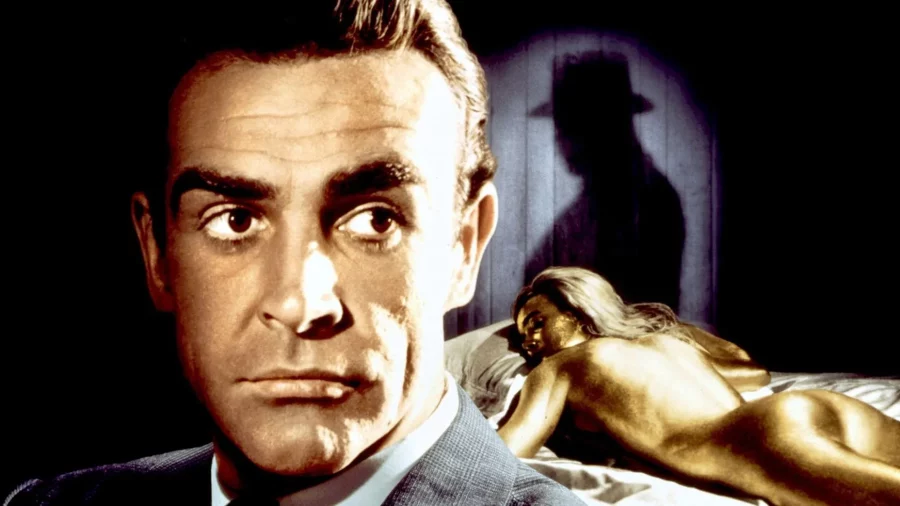
Laura Mulvey’s idea of the male gaze is often used to explain how films make women look like objects that exist mainly for male pleasure. But this theory also tells us something bigger. It is not only shapes how women are shown on screen, but also creates a fixed way of thinking about what men should be looking like and how gender roles work in the media.
In many movies, women are filmed in a way that highlights their bodies, but men are treated differently. The male gaze expects male characters to be strong, confident, and always in control. For example, characters like James Bond rarely show weakness, and superhero films use very muscular bodies to represent the “ideal man.” These images can make male audiences feel pressure, because the standard is impossible to reach in real life. In this way, the male gaze does not only show desire, it also teaches men how they “should” behave.

The gaze also affects who gets power in the story. In classical Hollywood films, and many modern ones too, male characters often make important decisions and move the plot forward. Women, however, are sometimes placed in roles like the love interest, the emotional supporter, or someone who needs help. Their stories are usually told through a man’s perspective. This shows how narrative authority is divided in between genders.
The male gaze also makes it difficult for characters who do not fit traditional heterosexual masculinity to appear in mainstream films. LGBTQ+ or characters who do not fit traditional gender expectations are often reduced to very simple roles, or they are used only as symbols. This lack of representation shows how the gaze creates a hierarchy in which some genders are treated as more important or more “normal” than others.
By looking at the male gaze in this broader way, we can see how it influences more than just how women are viewed. It also controls how men are expected to act and pushes aside identities that do not follow the usual gender norms. In the end, the gaze decides not only who appears on screen, but also whose experiences are considered meaningful.
Reference
Mulvey, L. (1975). Visual pleasure and narrative cinema. Screen, 16(3), 6–18.
Neale, S. (1983). Masculinity as spectacle: Reflections on men and mainstream cinema. Screen, 24(6), 2–17.
Tasker, Y. (1993). Spectacular bodies: Gender, genre, and the action cinema. Routledge.
Modleski, T. (1988). The women who knew too much: Hitchcock and feminist theory. Routledge.


You explained the theory well and from a more unique perspective, showing how men are also affected by the male gaze in media. I like your examples, and your point about how men control the narrative in films, while women act as love interests or etc. You also made a strong point about how LGBTQ+ and gender nonconforming communities are presented in the media, and how the male gaze also affects them. Maybe you could provide a counter argument against the male gaze, or show how it can be found in other mediums – not just film.
This is such a sharp, eye-opening angle on the male gaze—loving how you apply it to male characters too .the Daniel Craig example is perfect for grounding this!. It adds so much nuance to talk about how the gaze pressures men into rigid ideals, not just objectifies women. A tiny tweak: you could briefly note how this “ideal man” standard also limits male character complexity to make the point even punchier. Awesome, thoughtful analysis!
You show a different view of male gaze, how male gaze affects men, not only women through media. And there is a difference between the role of men and women in movies. That’s ok, but I recommend you can give some examples outside of western world, many countries don’t have these phenomena. Like in Japan, some main male characters are weak and pushed by female characters. And there is also a big difference in China.
Your explanation of Laura Mulvey’s theory on the male gaze is very clear, easy to read and understand. And I really like how you talk about how the male gaze is not just about the viewing of a woman’s body in a sexual or objectified way, but is also being about how the male leads are portrayed with massive mussels and six packs and that they are in control a lot of the time and move the story forward. It was also a good observation on how the male gaze also affects LGBTQ+ people and non gender conforming people.