
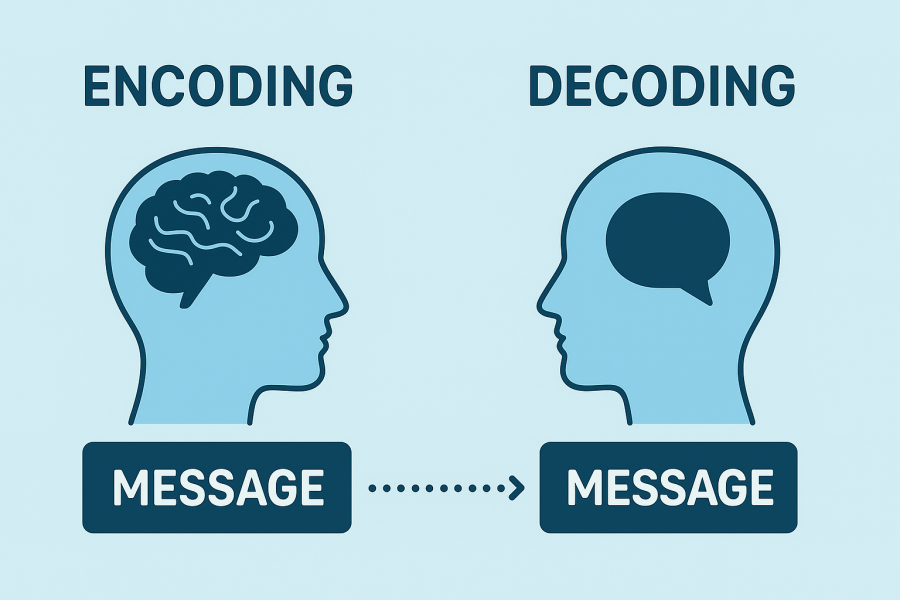
We’re all surrounded by messages, constantly. Whether it’s through the ads we see, the content on social media, or even the products influencers rave about, we’re bombarded with information every day. But have you ever stopped to think about how these messages are put together and how we, as viewers, actually interpret them? That’s where the idea of encoding and decoding comes in.
What is Encoding?
In simple terms, encoding is how information is created and shaped to communicate a message. Think of it like the “packaging” of an idea or product. Brands, companies, and influencers all encode their messages in specific ways to get our attention. They choose their words carefully, pick certain visuals, and design ads to make us feel something excitement, desire, urgency. It’s like when you see a shiny new product on Instagram, looking all perfect, and you just have to get it. That’s encoding at work. They’re sending out a message that’s wrapped up in signs, symbols, and emotions to convince you to take action.
What is Decoding?
Now, decoding is all about how we, the consumers, break down and interpret that message. When we see an ad, or a social media post, we don’t just accept it at face value. We process it in our own way. Some of us might look at a product and think, “Yeah, that looks amazing, I’m sold.” Others might question it: “Is this really as good as they say it is?” Or maybe we criticise it: “This is just another gimmick.” Decoding is like the mental work we do to figure out what’s really being communicated, often by looking beyond the surface. And let’s be real a lot of times, thesemessages are designed to manipulate or influence us in ways we don’t even realize.
The Role of Influencers in Social Media
Take social media, for example. Influencers are everywhere, and they’re constantly telling us what to buy, what to wear, what to try. You’ve probably seen them say things like, “I’m obsessed with this product!” or “This is the best thing I’ve ever tried!” They’re using super enthusiastic language to make us believe that if we buy what they’re selling, we’ll have a piece of that perfect life too. It’s encoding at its finest they’ve wrapped up the message in a shiny package that’s hard to resist.
But not everyone falls for it. Some of us start questioning: “Wait, does this beauty product really work like they say it does? Is it actually natural, or is it full of chemicals?” So, we go and do a little research. We decode the message by looking at the ingredients or reading reviews to figure out what’s really going on. Sometimes, we even find that the product isn’t as great as it’s been made out to be. That’s the power of decoding we start to peel back the layers and see things for what they really are.
The Power of Critical Thinking
There’s also this podcast I listen to sometimes called Jumpers Jump, where the hosts dive deep into theories behind viral TikTok videos, artists, or movies. They connect dots, look for hidden messages, and question the narratives people are pushing on social media. It’s a form of decoding they’re analyzing content and trying to uncover the deeper meaning behind it, even if it’s something that seems harmless at first glance.
In today’s world, where media is everywhere, it’s so easy to just absorb whatever we see and hear without thinking twice. But that’s dangerous. We need to remember that a lot of what we consume is crafted to make us think a certain way or to get us to buy something. The more we learn to decode the messages we’re presented with, the better equipped we are to make informed decisions about what we support and what we reject.

Question Everything
So, what’s the takeaway here? In a world where media influences so much of our lives, it’s crucial to slow down and question the messages we’re consuming. Instead of just accepting things at face value, we should challenge ourselves to decode the hidden motives behind ads, influencer posts, and even the content we scroll through on our feeds. The more we do this, the more we take control of our own thoughts and decisions, instead of just being passive consumers of whatever is fed to us.
At the end of the day, being critical doesn’t mean we have to reject everything. It just means we need to make sure we know why we agree with something, and whether it’s really as great as it’s made out to be.
So next time you see a product, or an influencer post, or even just a viral trend ask yourself: What’s really being communicated here? And more importantly, who benefits from me believing it?


This blog does a good job explaining encoding and decoding in a way that feels relatable, especially with the examples from Instagram ads and influencer culture. The point about how people don’t all read a message the same way is clear and realistic, and the reference to the Jumpers Jump podcast adds a nice personal touch that makes the argument feel grounded. You also highlight why critical thinking matters without sounding overly academic. One small suggestion is to link the ideas back to media theory a bit more directly, but overall the piece is engaging, easy to follow, and makes the reader reflect on how they interpret everyday content.
This blog does an excellent job in de & encoding the reading and processing of data and presenting it in a manner that is easy to follow and relate to. The examples, such as the influencers on Instagram to podcast conversations, assist in relating theory to the real world and, as a result, make the subject matter interesting and reachable.
The structure is one of the areas that you can get stronger. Certain paragraphs are somewhat lengthy, and more distinct transitions or subheadings would allow directing the reader through each point in a more smooth way. It could be another good idea to provide one or two real-life examples (a certain ad or a specific trend) to further the analysis and to make the proceedings of encoding/de-coding even more image-intensive.
On the whole, the tone of the conversation is quite effective and the appeal to take media seriously is strong. This can be even more convincing and informative with a slight tightening and several added examples.
A great analysis of Hall’s paradigm in relation to social media. The most important aspect of this theory, particularly in the present day, is the idea of “oppositional decoding.”
As consumers, we are not merely engaging in a “negotiated” reading when we actively challenge an influencer’s post, look for unsponsored reviews, or research ingredients (as you mention). Instead, we are frequently taking a completely oppositional stance and rejecting the brand’s dominant, consumerist message. The difficulty of critical thinking in the attention economy only serves to highlight the strength of the initial encoding drive.