

In today’s digital world, our identities are not fixed anymore. Instead, they are something we show and change across different online platforms. A good example is Kim Kardashian. She is a celebrity, an influencer, and also a businesswoman. Her online image shows how a person’s identity can be shaped and rebuilt through media.
Erving Goffman (1959) said that social life is like a stage, and people act differently when facing different audiences. On Instagram, Kim usually shows a very polished side of herself: perfect makeup, expensive clothes, and a luxury lifestyle. This version of her is made to fit what her followers want to see, and it creates an image of beauty and success. However, on Keeping Up with the Kardashians or when she shares more personal posts, we can see another side. In those moments, she is also a mother, a sister, and someone who deals with everyday problems.
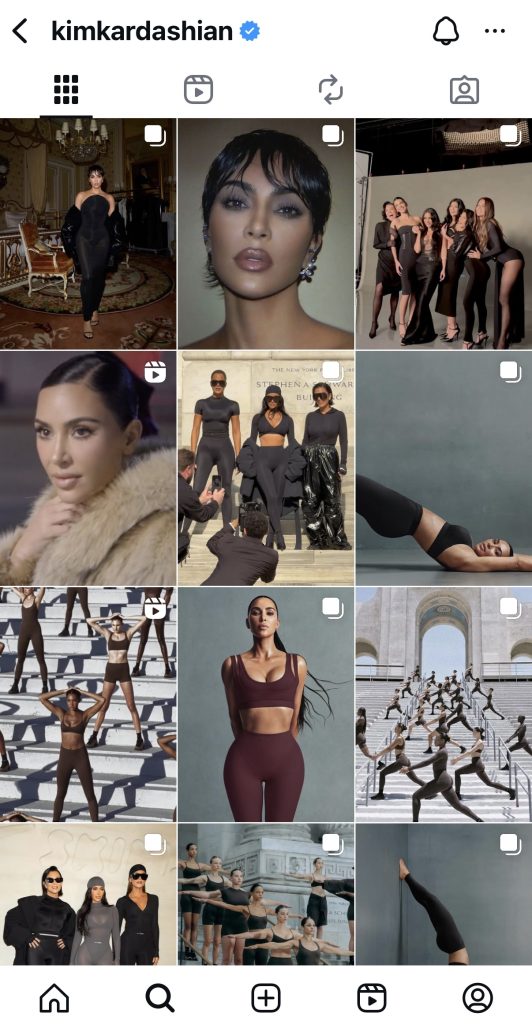

Marshall McLuhan (1964) said, “the medium is the message,” which means the platform influences how messages are presented. Instagram is very visual, so Kim uses it to share well-edited photos and professional branding. Twitter (now X), which is text-based and faster, used to show more casual posts, short thoughts, or quick replies. Even if she talks about the same topic, the feeling of the message becomes different. On Instagram, she looks glamorous, but on Twitter, she sounds more direct and conversational.
Judith Butler (1990) explained that identity is something we perform again and again. Kim’s selfies, fashion looks, and family pictures are not random posts. They help her repeat a certain image of herself, and over time, this becomes her public identity and her brand.
In the digital age, identity is both created and performed. Kim Kardashian shows how modern celebrities build who they are through different platforms. Every photo, video, or short message helps her shape her online self. It is not completely fake, but it is a performance that is carefully planned for the online world.
Reference
Butler, J. (1990). Gender Trouble: Feminism and the Subversion of Identity. New York: Routledge.
Goffman, E. (1959). The Presentation of Self in Everyday Life. New York: Doubleday.
McLuhan, M. (1964). Understanding Media: The Extensions of Man. New York: McGraw-Hill.


This is a really well-structured post that explains how Kim Kardashian constructs her identity across various media platforms. It effectively uses Goffman, McLuhan, and Butler to demonstrate that her public image is not accidental but shaped by the medium and repeated performance. The comparison between her Instagram presence and her appearances on Keeping Up With the Kardashians highlights the difference between a curated image and a more personal one. McLuhan’s idea that “the medium is the message” is particularly relevant, as it illustrates how each platform influences Kim’s presentation and how audiences interpret her identity. The link to Butler also proves useful in showing how her consistent content, including fashion, family moments, and branding, forms a cohesive public identity over time. Overall, this post clearly explains how Kim Kardashian uses digital platforms to shape her brand and how identity is created through ongoing performance rather than something fixed.
Your blog addresses its topic very well, seamlessly blending from discussing Goffman and his theory to a specific example, Kim Kardashian and her online identity. I particularly like the contrast between her Instagram and her television show, as it reinforces your point effectively. This post effectively analysis the theory of constructing a digital identity in a modern world. In order to delve deeper into this topic, you could consider if it is Kim Kardashian who determines her online identity, or her audiences expectations and the media systems’ algorithms. Furthermore, you could consider if commercialisation has an influence on the Kardashian’s authenticity, especially in her television show.
Your analysis does a great job connecting theory to practice by using Kim Kardashian as an example of identity construction in the digital age. I like how you incorporated Goffman, McLuhan, and Butler to frame the discussion—it shows strong theoretical grounding. One suggestion would be to tighten the flow and clarify transitions between ideas. For instance, when moving from Goffman’s “stage” metaphor to McLuhan’s “the medium is the message,” you could explicitly link how the platform (Instagram vs. Twitter) influences the type of performance. Also, consider addressing the phrase “our identities are too fixed” at the beginning—it seems like a typo and could be revised to “not fixed.” Finally, you might expand on the idea that these performances are “not fake but planned”—perhaps by briefly discussing the tension between authenticity and branding in influencer culture. Overall, this is a thoughtful and well-supported piece!
This article on digital identity construction shows a clear discussion structure and a solid theoretical foundation. The article successfully took Kim Kardashian as a typical case, organically integrating Gofman’s drama theory, McLuhan’s media theory and Butler’s performance identity theory, forming a multi-level analysis perspective and rigourous logical discussion, from the differences in identity performance of different social platforms to the influence of media characteristics on information transmission. Sound, and then to the process of identity being consolidated through repeated performance, the duality of digital identity is revealed layer by layer, which is both a product and a performance. The article accurately applies the theory, especially expanding Butler’s gender performance theory to a wider range of identity construction, reflecting the contemporary applicability of the theory. The case selection is very representative, and Kim Kardashian’s cross-platform image comparison vividly supports the core argument. If it can be slightly extended at the level of commercial brand construction and analyse the relationship between its identity performance and capital operation, it will make the discussion more critical and in-depth. The format of references is standardised and the source is authoritative, which provides reliable support for the discussion.